
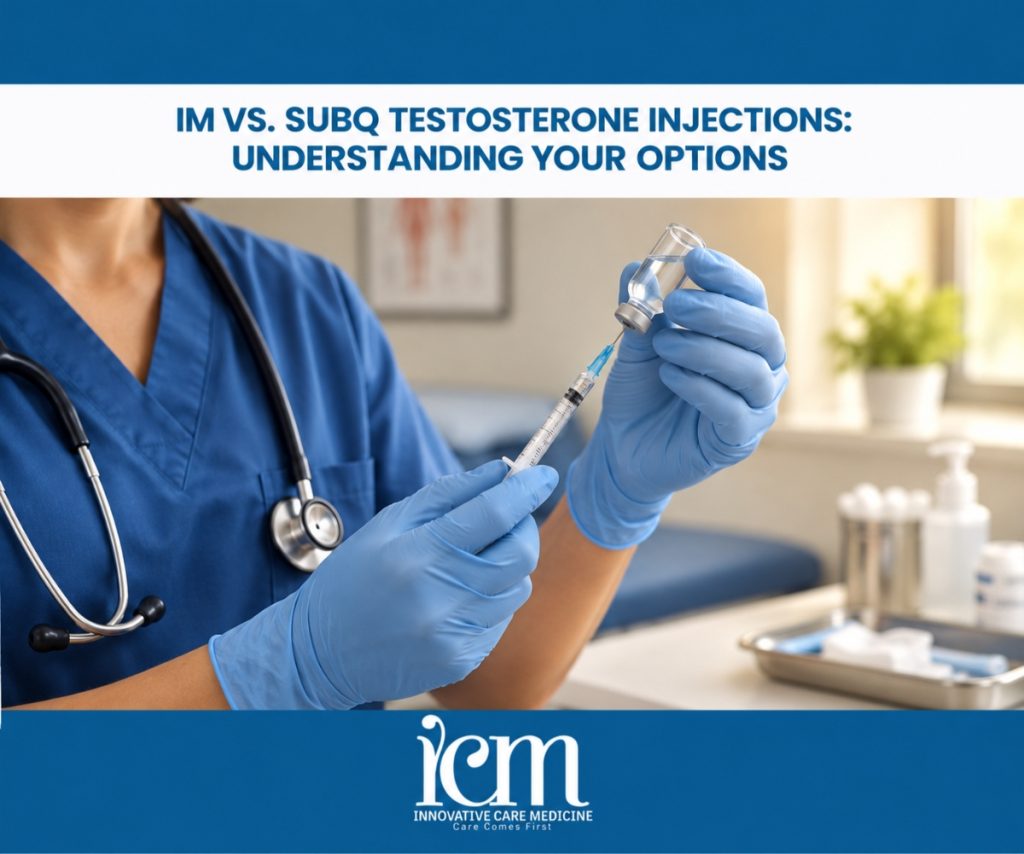
IM vs. SubQ Testosterone Injections: Understanding Your Options
Testosterone levels play an important role in several aspects of health, including sexual function, muscle maintenance, bone health, and overall well-being. When a person has symptoms associated with testosterone deficiency and testing confirms consistently low levels, a healthcare provider may discuss whether testosterone replacement therapy (TRT) is appropriate.
For patients prescribed injectable testosterone, two administration methods may be considered: intramuscular (IM) injections and subcutaneous (SubQ) injections. Although both methods deliver testosterone into the body, they differ in where the medication is injected, the equipment used, and the experience of administering the medication.
Understanding these differences can help you have a more informed conversation with your healthcare provider. The right approach depends on your prescribed medication, medical history, treatment goals, and individual preferences.
Key Takeaways
- IM and SubQ injections: Both methods can be effective when the medication, dosage, and administration route are appropriate for the patient.
- Intramuscular injections: These deliver testosterone into muscle tissue and have been widely used in testosterone therapy for many years.
- Subcutaneous injections: These deliver medication into the fatty tissue beneath the skin and may be easier for some patients to administer after receiving proper instruction.
- Individualized treatment: The most suitable method depends on factors such as the testosterone formulation, dosing schedule, comfort, and medical needs.
- Ongoing monitoring: Regular medical follow-up and laboratory testing help evaluate treatment response and identify potential adverse effects.
What Is the Difference Between IM and SubQ Testosterone Injections?
The main distinction between these methods is the tissue into which the medication is delivered. Your healthcare provider will determine the appropriate route according to your prescription and the formulation being used.
Intramuscular (IM) Injections
An intramuscular injection places testosterone directly into a muscle. Depending on the prescribed medication and the instructions provided by the healthcare professional, common injection sites may include the thigh or gluteal muscle.
This method has a long history of use in testosterone replacement therapy. Its effectiveness and dosing schedule depend on the specific testosterone preparation, the prescribed dose, and how the individual responds to treatment.
Subcutaneous (SubQ) Injections
A subcutaneous injection delivers testosterone into the layer of fatty tissue just beneath the skin. Depending on the medication and its instructions, possible injection sites may include the abdomen or thigh.
SubQ administration is an option for certain testosterone preparations and may be more convenient for patients who have received appropriate training for self-injection. Some people also find that using a smaller needle makes the process more comfortable.
Not every testosterone product is intended for both routes. Patients should use only the administration method specifically prescribed by their healthcare provider.
Advantages and Considerations of IM Testosterone Injections
Potential Advantages
- Established treatment method: Intramuscular testosterone has been used extensively in clinical practice.
- Predictable treatment schedules: Depending on the formulation and prescribed regimen, IM therapy can provide a structured dosing schedule that fits a patient’s routine.
- Established clinical experience: Healthcare professionals have substantial experience prescribing and monitoring several forms of injectable testosterone delivered into muscle tissue.
- May suit individual preferences: Some patients prefer this route based on their treatment history, prescription, or comfort with the administration method.
Potential Considerations
- Injection discomfort: A deeper injection can cause temporary soreness, tenderness, or discomfort at the injection site.
- Needle requirements: IM administration typically requires a needle suitable for reaching the muscle.
- Changes in hormone levels: Certain testosterone formulations and dosing schedules may cause fluctuations in testosterone concentrations between injections.
- Administration technique: Patients who self-inject need clear instructions on proper technique, injection sites, and safe needle disposal.
Who might consider IM injections? This route may be appropriate for patients whose prescribed medication is intended for intramuscular administration and whose treatment preferences and medical circumstances support that approach. The dosing interval should be determined by the formulation and the prescribing clinician.
Advantages and Considerations of SubQ Testosterone Injections
Potential Advantages
- Smaller needle options: Some SubQ regimens use smaller needles than traditional IM injections, which may improve comfort for certain patients.
- Convenience: With appropriate training and a suitable prescription, the technique may be easier for some patients to perform at home.
- Potentially comparable testosterone levels: Published research suggests that appropriately prescribed SubQ testosterone can achieve testosterone levels comparable to those seen with IM administration in studied regimens.
- Alternative administration method: SubQ delivery may be worth discussing when a patient is concerned about the discomfort or practical challenges of intramuscular injections.
Potential Considerations
- Local skin reactions: Redness, tenderness, swelling, or irritation may occur at the injection site.
- Product-specific instructions: The appropriate injection route depends on the particular medication and formulation prescribed.
- Individual dosing needs: Injection frequency varies according to the product, dosage, and clinical plan. Some regimens require more frequent administration than others.
- Proper training: Patients should receive professional guidance before administering injections themselves.
Who might consider SubQ injections? This approach may suit patients whose prescribed testosterone preparation can be administered subcutaneously and who value a potentially more manageable self-injection technique. A healthcare provider should determine whether it is appropriate for the individual.
What Does Research Say About IM vs. SubQ Testosterone?
Research has examined whether delivering testosterone into muscle or beneath the skin affects hormone levels, treatment convenience, and safety. Findings are encouraging for SubQ administration, although the available evidence does not establish that one route is best for every patient.
A review published in The Journal of Clinical Endocrinology & Metabolism in 2022 examined research on subcutaneous testosterone administration. The authors reported that the available evidence supported SubQ testosterone as a practical treatment option, with comparable testosterone exposure and average hormone levels to IM administration in studied regimens. They also noted that SubQ administration may be easier to perform and less uncomfortable for some patients. The authors emphasized that additional direct comparisons were needed.
Read the 2022 review on subcutaneous testosterone therapy.
A separate study published in The Journal of Urology in 2022 compared men treated with weekly intramuscular testosterone cypionate and a weekly subcutaneous testosterone enanthate autoinjector. Both groups experienced increases in testosterone levels. After adjustment for relevant factors, the SubQ group had lower post-treatment estradiol and hematocrit levels in that study.
These results are specific to the preparations and regimens examined. They should not be interpreted as proof that every SubQ product is safer than every IM product or that every patient will experience the same results.
Read the comparative study in The Journal of Urology.
Overall, research supports considering SubQ administration as an option when clinically appropriate. More direct comparative research is needed to determine how different formulations and dosing approaches affect outcomes across a broader range of patients.
Which Is Better: IM or SubQ Testosterone?
There is no single answer that applies to everyone. Both approaches may be suitable when prescribed correctly, but the best choice depends on the medication, the person’s health, treatment response, comfort, and ability to follow the recommended schedule.
During a medical consultation, your healthcare provider may consider:
- Laboratory results: Testosterone levels should be evaluated alongside relevant symptoms and medical history.
- Treatment goals: The care plan should reflect the reason for treatment and the outcomes that can reasonably be expected.
- Medication formulation: Not all testosterone preparations can be administered through either route.
- Comfort and convenience: Needle size, injection technique, and dosing frequency may influence your preference.
- Safety considerations: Existing medical conditions, potential adverse effects, and other medications may affect treatment decisions.
- Ongoing response: Follow-up appointments and laboratory measurements help determine whether the current approach remains appropriate.
Testosterone therapy should be considered only after an appropriate medical evaluation. Symptoms alone are not enough to establish testosterone deficiency; diagnosis generally requires compatible symptoms and consistently low testosterone measurements.
Review the Endocrine Society’s clinical guidance on testosterone therapy.
Why Medical Supervision Is Important
Choosing an injection method is only one part of testosterone replacement therapy. Safe treatment also involves determining whether therapy is appropriate, selecting the correct medication and dosage, providing administration instructions, and monitoring the patient’s response.
Depending on the individual clinical situation, medical follow-up may include:
- Assessing symptoms, medical history, and possible causes of testosterone deficiency.
- Checking testosterone levels before and during treatment.
- Monitoring hematocrit, a measure related to the proportion of red blood cells in the blood.
- Discussing prostate health and appropriate monitoring when relevant.
- Reviewing side effects and making treatment adjustments when indicated.
- Discussing fertility plans, because testosterone therapy can suppress sperm production and may not be suitable for people planning to conceive in the near term.
Patients should not start testosterone therapy, change their dosage, or switch between IM and SubQ administration without guidance from their prescribing healthcare professional. Using the wrong route or an inappropriate regimen can increase the risk of complications.
Explore Hormone Care Options With Innovative Care Medicine
Questions about hormone levels, energy, sexual health, or other changes in well-being are worth discussing with a qualified healthcare professional. An individualized evaluation can help determine whether hormone testing or treatment may be appropriate for your circumstances.
At Innovative Care Medicine, you can discuss your health concerns and learn more about available care options, including hormone-related care. Your healthcare provider can help you understand the potential benefits, limitations, and risks of different approaches based on your medical needs.
To get started, call (951) 356-9992 or request an appointment online.
request an appointmentFrequently Asked Questions
Are IM and SubQ testosterone injections equally effective?
Both methods can effectively deliver testosterone when the medication, dose, and administration route are appropriate. Research suggests that SubQ treatment can achieve comparable testosterone levels in studied regimens, but results depend on the formulation and individual treatment plan.
Are SubQ injections less painful than IM injections?
Some patients find SubQ injections more comfortable because the technique may use a smaller needle and does not require reaching muscle tissue. However, comfort varies, and either method can cause discomfort or a local reaction.
Can I switch from IM to SubQ injections on my own?
No. The suitability of a different injection route depends on the specific medication and prescription. Consult your healthcare provider before making any changes.
How often does testosterone need to be injected?
The schedule depends on the testosterone preparation, dose, and clinical goals. Some regimens involve more frequent injections than others. Your prescribing clinician should provide an individualized schedule.
Do I need blood tests while receiving testosterone therapy?
Yes. Appropriate monitoring is an important part of treatment. Depending on your circumstances, your healthcare provider may assess testosterone levels, hematocrit, symptoms, adverse effects, and other relevant health measures at recommended intervals.
Final Thoughts
The choice between intramuscular and subcutaneous testosterone injections involves more than selecting a needle or injection site. Both methods have potential advantages and limitations, and the most suitable option depends on the prescribed formulation, individual preferences, and medical circumstances.
Rather than choosing a method based on general comparisons alone, speak with a qualified healthcare professional about your symptoms, laboratory results, treatment goals, and ongoing monitoring needs. An informed, individualized plan is essential to making decisions about testosterone therapy.
Medical disclaimer: This article is intended for educational purposes only and does not replace professional medical advice, diagnosis, or treatment. Testosterone therapy is not appropriate for everyone. Consult a qualified healthcare professional to discuss your individual circumstances.
Contact Innovative Care Medicine
📍 Corona Location
818 Magnolia Ave., Ste. #201
Corona, CA
📍 Riverside Location
9493 Garfield St.
Riverside, CA
📞 (951) 356-9992
🌐 innovativecaremed.com
References
- Figueiredo MG, Gagliano-Jucá T, Basaria S. Testosterone Therapy With Subcutaneous Injections: A Safe, Practical, and Reasonable Option. The Journal of Clinical Endocrinology & Metabolism. 2022;107(3):614–626. https://doi.org/10.1210/clinem/dgab772
- Choi EJ, Xu P, Barham D, et al. Comparison of Outcomes for Hypogonadal Men Treated with Intramuscular Testosterone Cypionate versus Subcutaneous Testosterone Enanthate. The Journal of Urology. 2022;207(3):677–683. https://doi.org/10.1097/JU.0000000000002301
- Bhasin S, Brito JP, Cunningham GR, et al. Testosterone Therapy in Men With Hypogonadism: An Endocrine Society Clinical Practice Guideline. The Journal of Clinical Endocrinology & Metabolism. 2018;103(5):1715–1744. https://doi.org/10.1210/jc.2018-00229